
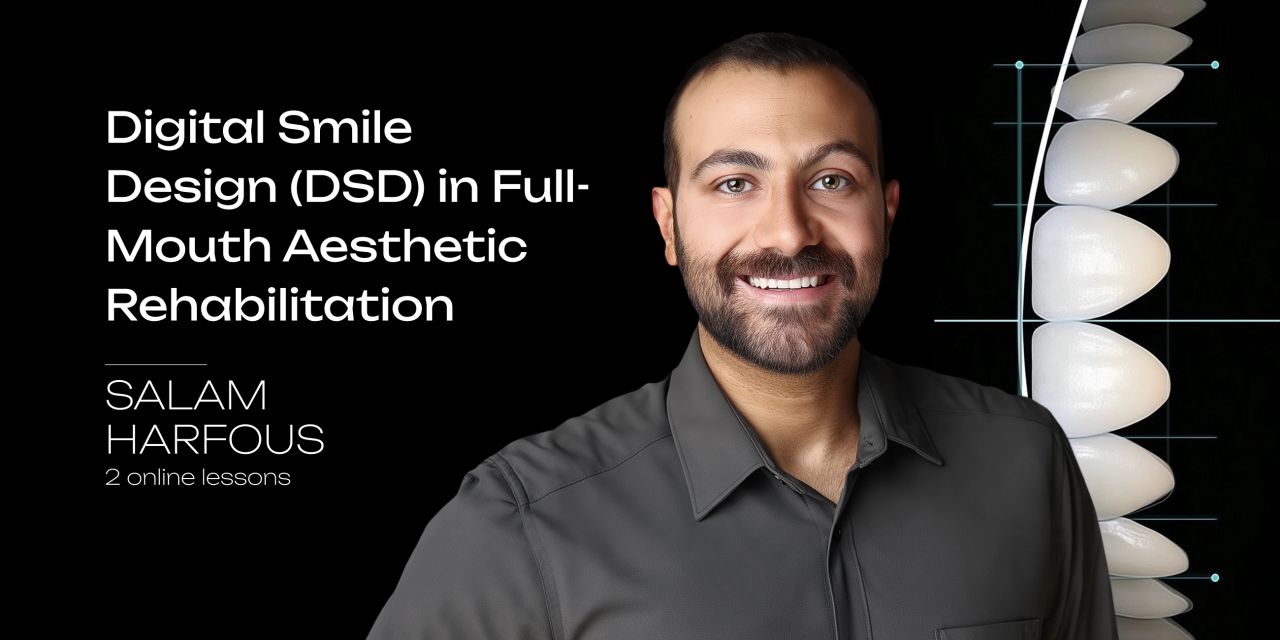
Digital Smile Design (DSD) in Full-Mouth Aesthetic Rehabilitation
Integrate facial analysis, AI-driven diagnostics and biological principles to plan predictable full-mouth aesthetic rehabilitation.

Digital Smile Design (DSD) in Full-Mouth Aesthetic Rehabilitation
Salam Harfoush
Erhalte Zugriff auf diesen Kurs und über 1 200 Stunden Lerninhalte mit Premium.
Was ist in enthalten
Dieser Online-Kurs
Details
2 Lektionen (1S 15M)
1 CE Credits

Englisch
Zugang zur Aufzeichnung während der Premium-Periode
Beschreibung
Successful full-mouth aesthetic rehabilitation requires more than designing an attractive smile. It demands a comprehensive understanding of facial aesthetics, biological limitations, occlusal function and the relationship between digital planning and clinical reality.
This course explores the Digital Smile Design (DSD) philosophy as a systematic approach to diagnosing, planning and executing complex aesthetic rehabilitation cases. Particular attention will be given to facial analysis, AI-driven diagnostic tools and clinical techniques that help achieve harmonious, functional and biologically sound outcomes.
During the course, you will learn about:
— Digital Smile Design principles and their application to full-mouth aesthetic rehabilitation
— Facial analysis and the integration of facial proportions into smile design
— AI-driven analysis and digital tools for diagnosis and treatment planning
— Biological limitations and clinical considerations in aesthetic rehabilitation
— Aesthetic techniques and strategies for achieving harmonious, natural-looking results
— Full-mouth rehabilitation protocols, including the assessment and establishment of the vertical dimension of occlusion (VDO).
Lektion 1.Biological Limitations, Aesthetic Tricks, and Full-Mouth VDO Protocol
The second lesson addresses complex clinical scenarios, anatomical boundaries, and minimally invasive restoration techniques. You will learn to identify biological limitations (root exposure, gingival architecture, minimal gingival reduction) and master author-specific optical illusion techniques for recessed gingiva and wide embrasures. The lesson provides a comprehensive, step-by-step case walkthrough for increasing Vertical Dimension of Occlusion (VDO) from digital scanning and 3D printing to mock-up transfer, preparation through indices, and final delivery.
— Diagnostic boundaries: identifying clinical and biological limitations during digital smile design
— Managing gingival architecture: protocols for recessed gingiva and wide interdental spaces
— The author’s illusion technique: strategic contact extension to conceal black triangles and gingival defects
— Navigating biological limits: managing root exposure, tooth position anomalies, and soft tissue constraints
— Minimal gingival reduction: techniques to optimize aesthetic outcomes while preserving tissue
— Minimally invasive preparation protocol for veneers: utilizing depth markers on mock-ups
— Step-by-step execution of a complex clinical case with Vertical Dimension of Occlusion (VDO) increase:
- Digital intraoral scanning and articulation recording
- Controlled digital increase of the VDO.
— Selecting and finalizing the digital aesthetic design
— 3D printing of diagnostic models and intraoral mock-up placement
— Fabricating precision silicone indices for preparation and temporary restoration
— Minimally invasive tooth preparation through the mock-up
— Final digital impression scanning and CAD/CAM fabrication
— Seating and bonding of final aesthetic restorations.
Lektion 2.DSD Philosophy, Facial Aesthetics, and AI-Driven Analysis
This lesson explores why digital smile design is a clinical language rather than a simple software application. You will analyze the fundamental reasons dentists hesitate to adopt digital workflows, review the step-by-step DSD protocol, and clarify the division of responsibilities between the clinician and the dental technician. The lesson details why models that look perfect in software can fail aesthetically in vivo, demonstrating how to align software algorithms and Golden Proportion rules with real facial landmarks, incisal edge positioning, and individual patient proportions.
— Key barriers: 2 reasons clinicians remain stuck in conventional workflows and avoid digital adoption
— Comprehensive overview of the end-to-end Digital Smile Design (DSD) workflow
— Division of responsibilities: defining the roles of the dentist vs. the dental technician in digital design
— Clinical translation: comparing software mock-ups with clinically adjusted intraoral designs
— The vital role of the silicone index in achieving predictable final restorations
— Intraoral vs. model discrepancies: why software-perfect smiles fail on the patient's face
— Facial parameters and aesthetics: critical evaluation of the Golden Proportion in real-world dentistry
— Individualized design: how DSD calculates individual patient proportions and facial symmetry
— Software mechanics: how digital algorithms operate using literature criteria and AI tools
— Diagnostic sequencing: initial situation analysis and predictable final result visualization
— Treatment initiation: determining incisal edge position, reference ranges, and facial shape morphology.