
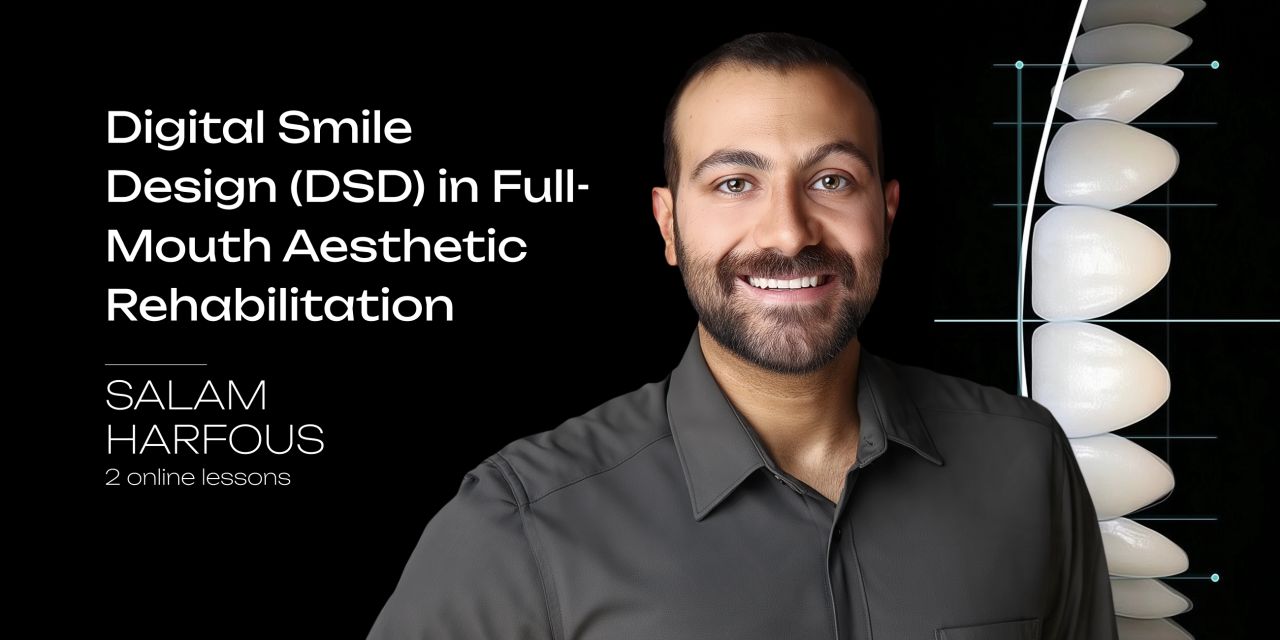
DSD Philosophy, Facial Aesthetics, and AI-Driven Analysis

DSD Philosophy, Facial Aesthetics, and AI-Driven Analysis
Salam HarfoushDer Unterricht ist in den nächsten Kursen enthalten:
Erhalte Zugriff auf diesen Kurs und über 1 200 Stunden Lerninhalte mit Premium.
Was ist in enthalten
Dieser Webinar
Details
36M
0.5 CE Credits

Englisch
Zugang zur Aufzeichnung während der Premium-Periode
Unterrichtsprogramm
This lesson explores why digital smile design is a clinical language rather than a simple software application. You will analyze the fundamental reasons dentists hesitate to adopt digital workflows, review the step-by-step DSD protocol, and clarify the division of responsibilities between the clinician and the dental technician. The lesson details why models that look perfect in software can fail aesthetically in vivo, demonstrating how to align software algorithms and Golden Proportion rules with real facial landmarks, incisal edge positioning, and individual patient proportions.
— Key barriers: 2 reasons clinicians remain stuck in conventional workflows and avoid digital adoption
— Comprehensive overview of the end-to-end Digital Smile Design (DSD) workflow
— Division of responsibilities: defining the roles of the dentist vs. the dental technician in digital design
— Clinical translation: comparing software mock-ups with clinically adjusted intraoral designs
— The vital role of the silicone index in achieving predictable final restorations
— Intraoral vs. model discrepancies: why software-perfect smiles fail on the patient's face
— Facial parameters and aesthetics: critical evaluation of the Golden Proportion in real-world dentistry
— Individualized design: how DSD calculates individual patient proportions and facial symmetry
— Software mechanics: how digital algorithms operate using literature criteria and AI tools
— Diagnostic sequencing: initial situation analysis and predictable final result visualization
— Treatment initiation: determining incisal edge position, reference ranges, and facial shape morphology.
Der Unterricht ist in den nächsten Kursen enthalten: